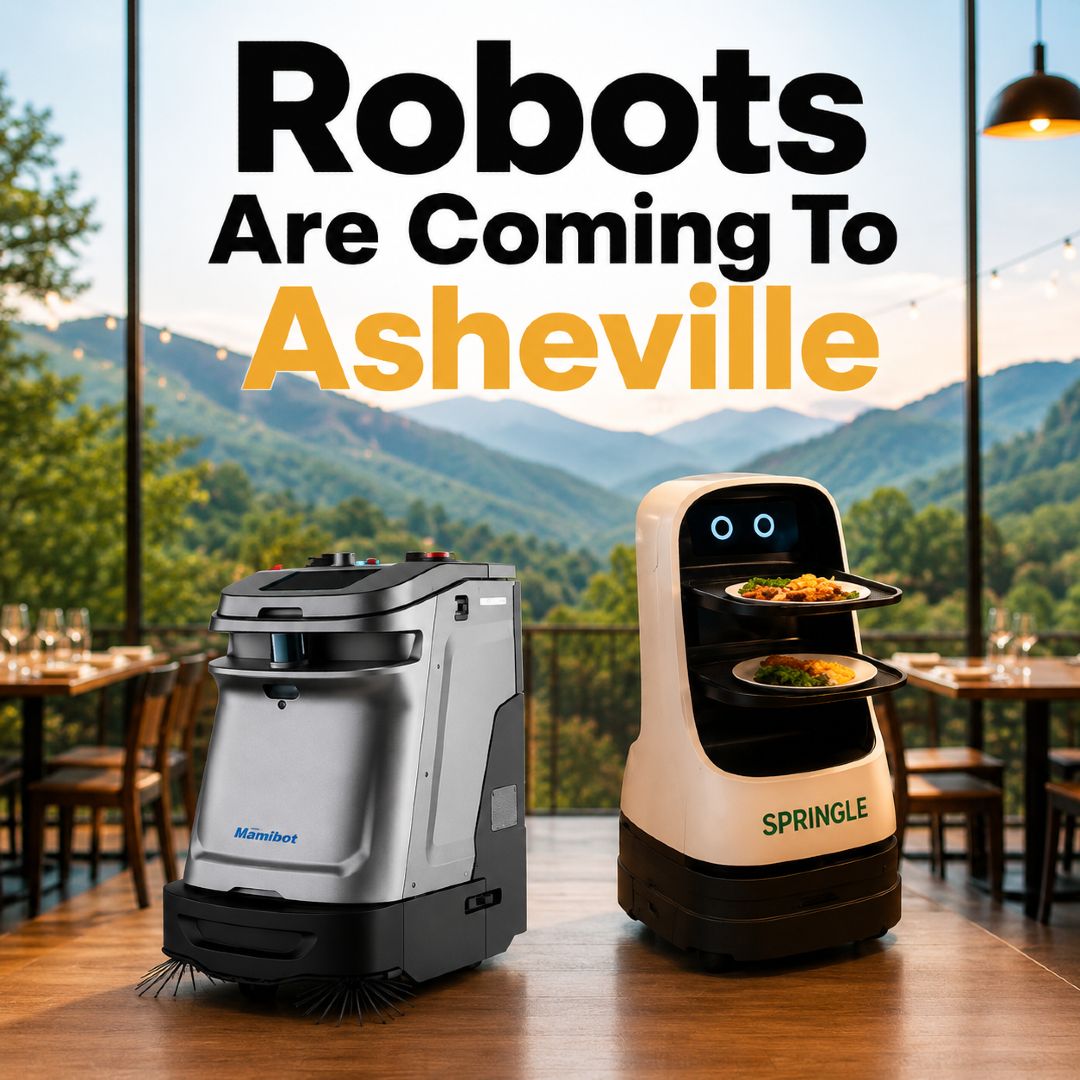
Well… You Could Say They’re Already Here.
Picture this:
You’re sitting in your favorite Asheville restaurant enjoying a locally brewed IPA and a farm-to-table burger when a robot rolls up to your table carrying some more food.
A few minutes later, another robot quietly glides across the floor cleaning the dining room without a single complaint, coffee break, or request for overtime.
Sound like science fiction?
Not anymore.
The robotic revolution has quietly arrived in Western North Carolina, and while most people haven’t noticed yet, some local businesses are already experimenting with robotics behind the scenes.
What’s even more surprising?
Many of these systems can be rented for as little as $17 per day—and unlike human employees, they can technically operate 24 hours a day.
The future isn’t coming.
It’s pulling into the parking lot.
Why Restaurants Are Looking at Robots
Let’s be honest.
The service industry has been through a rollercoaster over the last few years.
Staffing shortages, rising wages, increased operating costs, and employee burnout have forced restaurant owners to think differently about how they run their businesses.
Robots aren’t replacing the chef creating your favorite meal.
They’re not replacing the hostess greeting guests.
And they’re certainly not replacing the personality that makes Asheville restaurants unique.
What they are doing is handling repetitive tasks:
- Delivering food from the kitchen to tables
- Bussing dishes
- Cleaning floors
- Assisting staff during peak hours
- Reducing workload on already stretched teams
In many cases, these robots become an extra set of hands rather than a replacement for people.
The Big Question: Are Robots Taking Jobs?
Whenever new technology arrives, the same fear follows:
“What happens to the workers?”
It’s a fair question.
History shows us that technology often eliminates certain tasks while creating entirely new opportunities.
ATMs didn’t eliminate banking.
Computers didn’t eliminate offices.
The internet didn’t eliminate business.
Instead, each innovation changed how people worked.
Restaurant robotics may do the same thing.
Rather than spending hours carrying dishes back and forth, workers may focus more on customer service, management, hospitality, operations, marketing, or specialized skills that robots simply can’t replicate.
The reality is that robots are very good at repetitive tasks.
Humans are still much better at creativity, leadership, empathy, problem-solving, and building relationships.
What Does This Mean For Asheville?
Asheville has always embraced innovation while maintaining its unique culture.
As more businesses adopt robotics through the end of this year and beyond, local workers may find themselves asking an important question:
“How do I stay valuable in a changing world?”
The answer isn’t fighting technology.
The answer is learning how to work alongside it.
5 Ways People Can Adapt and Thrive in the Robotic Future
1. Move Toward Leadership Roles
Robots can carry food.
They can’t manage people.
Learning management, team leadership, scheduling, training, and operations can create opportunities that technology isn’t aggressively targeting.
Leadership remains one of the most valuable human skills.
2. Learn Technical Skills
Every robot needs setup, maintenance, monitoring, troubleshooting, and integration.
The demand for technicians, automation specialists, IT professionals, and robotics support personnel is expected to grow as adoption increases.
Someone has to keep the robots running.
Why not be that person?
3. Focus on Human-Centered Careers
Certain skills are difficult to automate.
Fields involving empathy, communication, relationship building, coaching, healthcare, education, counseling, sales, and community engagement will continue to rely heavily on people.
Human connection remains one of our greatest competitive advantages.
4. Invest in Continuous Learning
The days of learning one skill and using it for 40 years are disappearing.
Whether it’s certifications, trade programs, college courses, online learning, or apprenticeships, adaptability is becoming more valuable than any single skill.
The workers who continue learning will have the greatest opportunities.
5. Become the Bridge Between People and Technology
Businesses need people who understand both operations and technology.
Employees who can train teams, implement new systems, analyze data, and help organizations navigate change will become increasingly valuable.
The future belongs to those who can translate technology into real-world results.
Asheville’s Next Chapter
The Blue Ridge Mountains have witnessed incredible change over the decades.
From manufacturing to tourism, from craft breweries to technology startups, Asheville has continually evolved.
Restaurant robotics may simply be the next chapter.
Will some jobs change?
Absolutely.
Will new opportunities emerge?
Without question.
The businesses that adapt will become more efficient.
The workers who adapt will become more valuable.
And before long, seeing a robot delivering food across a restaurant floor may become just as normal as using a smartphone to order takeout.
The robotic future isn’t arriving someday.
It’s already here.
And Asheville is about to get a front-row seat.