Two years ago, much of Western North Carolina was trying to comprehend what had just happened to us. Hurricane Helene didn’t simply bring bad weather to the mountains. It tore through communities, businesses, roads, homes and livelihoods. Places we knew by heart suddenly looked unfamiliar. Families were displaced, businesses were interrupted or lost, and tourism—the economic lifeblood for thousands of people across our region—was shaken to its core.
Recovery was never going to happen overnight. Some of us probably thought we would be further along by now. Some businesses never reopened. Some families never returned. There are still scars throughout Western North Carolina that won’t disappear simply because nearly two years have passed. There is still work to do, money to invest, businesses to support and communities that need help finding their new normal.
But look at Asheville today.
The world has come to us.
Asheville is hosting G20 Finance Track meetings from August 29 through September 1, 2026, bringing finance ministers, central bank governors, deputies, senior officials, international media and others connected to some of the world’s most important economies right here to Western North Carolina. The U.S. Treasury has specifically connected Asheville’s selection with the revitalization and resilience of Western North Carolina as our region continues recovering from Helene.
That makes this about much more than another convention or government meeting coming to town. For Western North Carolina, it feels like a milestone. There is something incredibly meaningful about global economic leaders walking the streets of Asheville less than two years after floodwaters devastated communities across these mountains.
We haven’t completely recovered, but we are still here.
Our restaurants are serving people again. Our hotels are welcoming visitors. Artists are creating. Musicians are playing. Entrepreneurs are building. Small businesses are figuring out how to move forward. Tourism is returning. Communities that were knocked down have spent nearly two years getting back up, sometimes one customer, one visitor, one repaired building and one reopened business at a time.
Now Asheville isn’t appearing on television screens and in international media solely because something terrible happened here. This time, the world is seeing Western North Carolina because the world is doing business here.
That distinction matters.
In 2024, millions of people saw images of our disaster. In 2026, they have an opportunity to see our comeback.
The immediate economic benefits of an international gathering like this are fairly easy to understand. Hundreds of people coming into Asheville need hotel rooms, meals, transportation, coffee, entertainment and services. Local tourism officials previously projected roughly $1.5 million to $2 million in business revenue connected with the gathering. For a region where hospitality and tourism businesses have spent the past two years trying to regain their footing, that is meaningful economic activity.
But the dollars spent during these few days may not be the biggest opportunity G20 creates for Asheville.
The bigger opportunity could be what happens afterward.
International journalists are here. Government delegations are here. Finance ministers and central bankers are here. Staff members, business leaders and other influential visitors are seeing Asheville firsthand. Every photograph of our mountains that appears somewhere overseas, every television segment filmed here, every news story mentioning Asheville and every social media post showing somebody enjoying Western North Carolina introduces this region to people who may never have considered visiting us before.
That kind of exposure is difficult to measure immediately, but for a destination economy, it can be incredibly valuable.
Someone visiting from Japan for business may come back with their spouse. Someone from Europe may decide these mountains would make an incredible vacation. A journalist may go home talking about a restaurant they discovered. A government official may remember an Asheville entrepreneur or organization they met. Someone following the meetings from another country may see our mountains in the background of a television report and think, Where is that?
One visit can create another conversation, and another conversation can create another visit.
That is where the long-term potential becomes exciting.
We could see a fresh influx of visitors who discover Asheville because G20 first put the city on their radar. Delegates may return for personal trips with their families and friends. International media exposure can introduce Western North Carolina to new audiences. Business relationships formed here could potentially lead to future meetings, investment, partnerships and opportunities. Asheville can also demonstrate that it is capable of hosting complicated, high-profile international gatherings, potentially strengthening the region’s case for future conferences and events.
None of those future outcomes should be treated as guaranteed. But putting Western North Carolina in front of an influential international audience creates possibilities that simply didn’t exist before those people arrived.
And after everything this region has experienced, we should embrace those possibilities.
We don’t want the world’s lasting image of Western North Carolina to be flooded buildings, destroyed roads and heartbreaking images from Helene. Those images are part of our story, and they always will be, but they are not the end of our story.
Come back and see the breweries. Meet our artists. Eat at our independent restaurants. Visit Black Mountain. Explore Hendersonville. Drive through Waynesville. Experience Cherokee and the surrounding mountains. Walk through the River Arts District and meet the artists and business owners who rebuilt. Stay in our hotels, cabins and inns. Shop in our locally owned stores. Spend money with the small businesses that fought like hell to survive.
Then go home and tell somebody else about us.
That’s how exposure becomes tourism. That’s how tourism becomes economic activity. And that’s one of the ways recovery eventually becomes momentum.
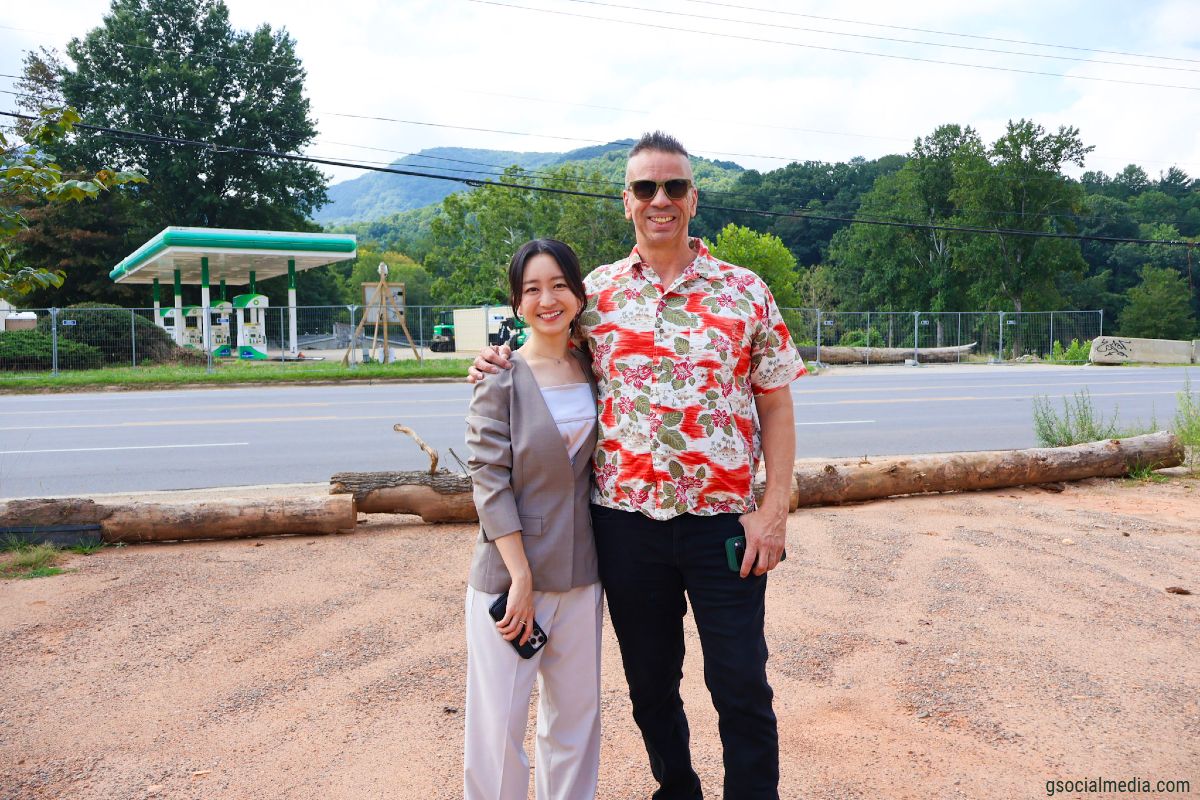
One of the most memorable parts of experiencing G20 in Asheville for us was getting to see that international connection happen personally when we had the opportunity to meet renowned Japanese journalist and television personality Akane Katafuchi.
Akane is from Saga Prefecture, Japan, and joined TV Tokyo in 2016, building an impressive career across Japanese television. Her work has included business and economic coverage as well as sports and entertainment programming, with credits associated with programs including Future Century Zipangu, FOOT×BRAIN and the long-running Shutsubotsu! Ad-machi Tengoku.
And suddenly, there she was in Asheville, North Carolina.
There is something wonderful about that. A journalist from Japan who has spent years helping audiences understand businesses, economies, sports, people and places around the world was now experiencing our little corner of that world.
That encounter helped put the significance of G20 into perspective for us.
This gathering isn’t only finance ministers and central bankers sitting around conference tables discussing global economic policy. Outside those meeting rooms, it is also people meeting people. It is cultures meeting cultures. It is journalists discovering communities. It is international visitors eating our food, seeing our mountains, meeting our residents and learning what Western North Carolina has endured.
And hopefully, they’re taking a little piece of Asheville home with them.
Hosting G20 certainly doesn’t mean Western North Carolina’s recovery is complete. Far from it. There are still businesses struggling. There are families whose lives changed permanently. There are infrastructure needs and communities where rebuilding has taken considerably longer than anyone hoped. Some of the consequences of Helene will be with us for years.
We shouldn’t pretend otherwise.
But perhaps recovery doesn’t have to mean rebuilding everything exactly as it existed before September 2024. Maybe recovery can also mean deciding what we want Western North Carolina to become next.
And perhaps having the world arrive at our doorstep represents one small but powerful moment in that transition.
The world learned about Asheville and Western North Carolina because of Helene. Now we have an opportunity to introduce ourselves again.
This time, we can tell a different story.
We can tell them about resilience without pretending the struggle is over. We can tell them about recovery while acknowledging how much remains unfinished. We can show them entrepreneurs who kept going, restaurant owners who reopened, artists who continued creating, tourism businesses that welcomed visitors back and communities that refused to disappear.
We can show them Western North Carolina.
So to the finance ministers, central bankers, journalists, television crews, staff members, families and visitors who have traveled here from around the world: Welcome to Asheville.
Eat somewhere local while you’re here. Buy something from an artist. Tip generously. Explore beyond the meeting rooms. Talk to the people who live here. Learn what happened to these mountains and what our communities have accomplished since. Come back with your families. Bring your friends. Tell people about the places you discovered.
And most importantly, remember us.
Nearly two years after one of the darkest moments in Western North Carolina’s modern history, something pretty remarkable is happening.
The world is looking at Asheville again.
This time, they aren’t only watching what happened to us.
They’re getting a chance to watch us come back.
Thank you, G20. Thank you to everyone who helped bring this gathering to Western North Carolina. Thank you to Akane Katafuchi and the international journalists who are sharing Asheville with audiences far beyond these mountains.
And thank you, World, for showing up in Asheville.
We still have work to do. We still have communities to rebuild, businesses to support and people who need help. Our comeback may have taken longer than some of us hoped, and it certainly isn’t finished.
But so many of us made it.
We’re still here. We’re still rebuilding. And now the world gets to see what comes next.
— To Asheville & Beyond