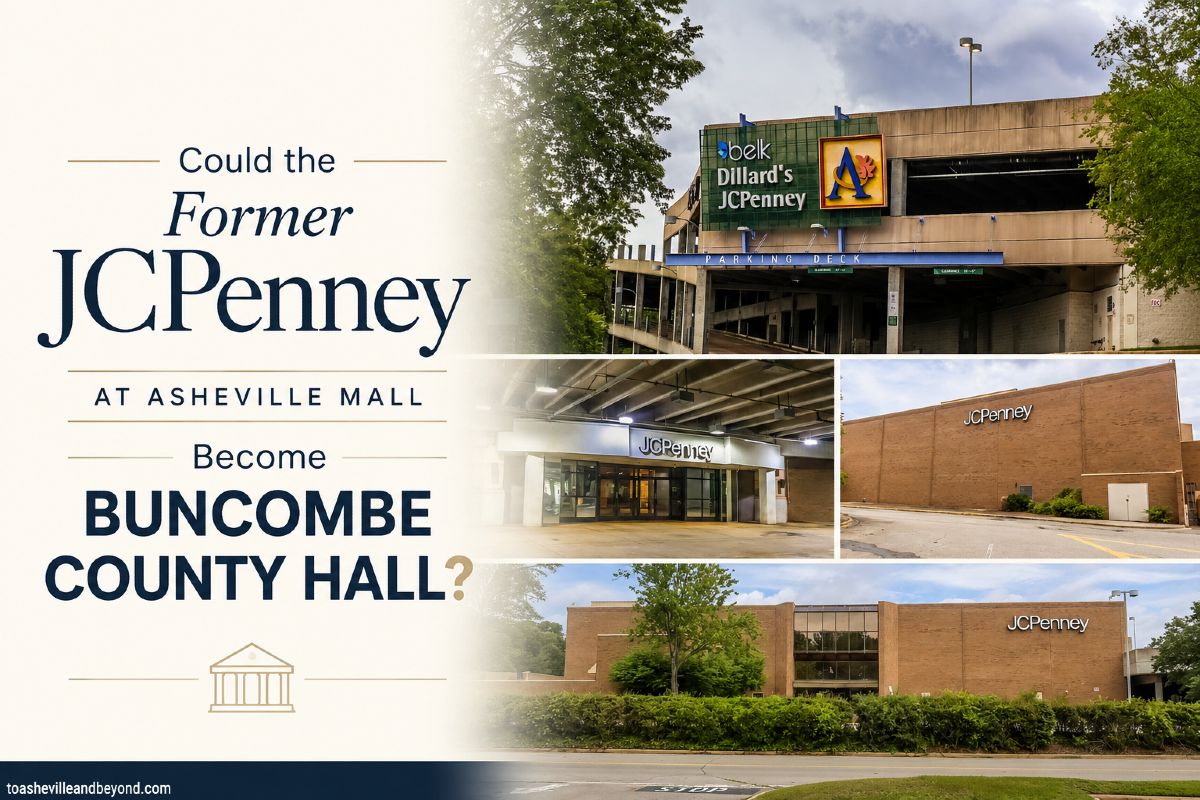
For years, Asheville’s conversation around growth has centered on housing, infrastructure, and how to modernize public services while preserving the character of the region. Now, a new possibility may be quietly taking shape inside one of the city’s most recognizable vacant retail spaces.
Multiple sources indicate the former JCPenney property at Asheville Mall could already be under contract as part of a larger Buncombe County facilities strategy. While no public budget document currently appears to explicitly identify the property by name, broader county capital and facilities categories suggest the groundwork for a major consolidation effort may already exist behind the scenes.
And honestly? The concept makes more sense than many people may initially realize.
Across the country, local governments have increasingly turned toward adaptive reuse projects — transforming vacant big-box retail stores into civic campuses, administrative offices, healthcare facilities, and public service centers. What once looked like retail decline is, in many communities, becoming an opportunity for reinvention.
A former department store checks several boxes governments care deeply about:
- Large existing footprint
- Extensive parking capacity
- Established utility infrastructure
- Strong roadway access
- Lower costs compared to new construction
- Ability to consolidate scattered departments into one central location
In neighboring Haywood County, officials explored a similar strategy involving the former Walmart property in Waynesville after the retailer relocated. The logic was simple: why spend years and significantly more taxpayer dollars building from scratch when large, functional structures already exist?
The same argument applies here.
The former JCPenney space sits attached to a struggling mall property at a time when traditional retail centers nationwide are being forced to evolve or redevelop entirely. Converting that anchor space into a centralized county government campus could simultaneously solve several problems at once.
For Buncombe County, it could mean modernized facilities, improved public accessibility, operational efficiency, and long-term cost savings.
For Asheville Mall, it could introduce stable daytime traffic and a new economic anchor at a moment when many malls are searching for relevance in a post-department-store era.
And perhaps most interestingly, centralizing county operations outside of downtown could potentially free up valuable county-owned properties and office space in the urban core — opening doors for redevelopment, housing opportunities, public-private partnerships, or entirely new civic uses.
That possibility alone could have long-term implications for downtown Asheville’s next phase of growth.
While some residents may initially find the idea unusual, adaptive reuse projects like this are becoming increasingly common because they reflect a broader shift in how communities think about land use, sustainability, and fiscal responsibility. Repurposing existing structures often moves faster, costs less, and creates less disruption than entirely new construction projects.
In many ways, it represents a more modern approach to government infrastructure.
Whether the JCPenney property ultimately becomes Buncombe County Hall remains to be officially confirmed. But if it does, the move would align closely with national redevelopment trends and could mark one of the more transformative property shifts Asheville has seen in years.
One thing is certain: “department store to government campus” was not on many people’s Asheville prediction cards for 2026.
Yet here we are — watching what may become one of the city’s most fascinating redevelopment stories unfold.
(This has been confirmed as of today, 5/27/26)