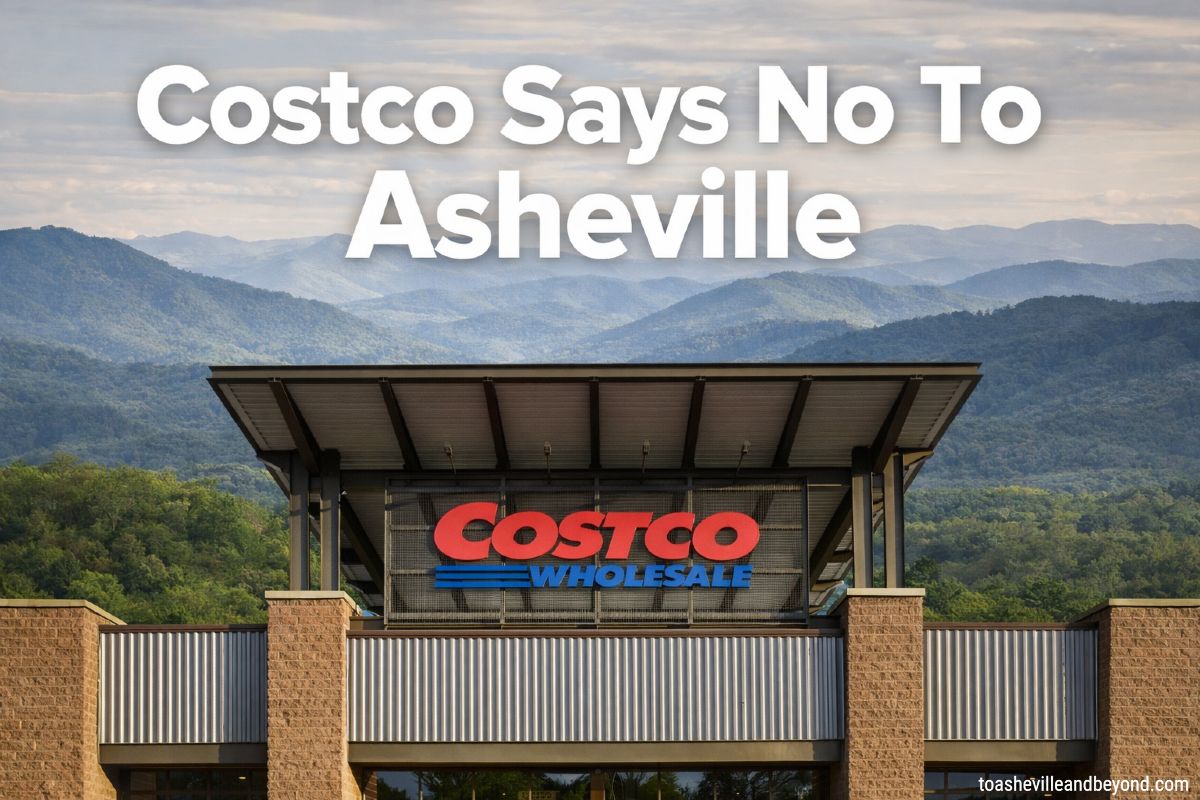
There’s a growing sentiment in the business world that national retailers look at Asheville and quietly move on.
Why?
Because doing business here is harder than it should be.
The Costco conversation isn’t just about a warehouse store. It’s about how Asheville positions itself for growth — and whether we’re serious about being business-friendly or just pretending to be.
Here are some of the reasons circulating publicly — and some that locals are saying privately.
1. Infrastructure That Wasn’t Ready
Smokey Park Highway traffic is already strained. That’s not Costco’s fault.
Major retailers expect cities to proactively address infrastructure. Instead, Asheville often pushes improvement costs onto developers. Growth requires preparation — not reaction.
Fix the roads because we need them fixed — not because someone else is willing to invest.
2. The “More, More, More” Negotiation Problem
National companies evaluate predictability.
When municipalities stack on last-minute conditions, added fees, or shifting expectations, projects stall. Asheville sometimes wants a premium return without offering streamlined certainty.
That reputation spreads.
3. Political Theater Over Policy
Photo ops don’t build economic stability.
When city leaders publicly celebrate a project while simultaneously creating regulatory hurdles behind closed doors, businesses notice. Corporate boards don’t operate on optics — they operate on risk analysis.
4. Process Fatigue
Asheville has boards, commissions, review panels, task forces, neighborhood coalitions, environmental overlays, and extended approval cycles.
Community input matters.
But endless layers create unpredictability. Retailers operate on timelines. Delay equals cost. Cost equals risk.
5. The “Anti-Big Business” Narrative
Asheville has long marketed itself as fiercely independent and small-business driven.
That’s beautiful.
But when that culture shifts into open resistance toward national brands — even ones known for high wages and strong benefits — it creates hesitation.
Costco isn’t a low-wage operator. Nationally, they’re known for:
- Above-average pay
- Strong benefits
- Employee retention
- Customer loyalty
Yet large-scale growth often meets immediate skepticism here.
6. Old Guard Economics
This one is sensitive.
Asheville has established players in retail, grocery, and development. When a company like Costco enters a market, it raises the competitive standard.
More selection.
More jobs.
More buying power staying local.
Not everyone benefits equally from that shift.
7. Housing & Workforce Pressure
News outlets frequently cite workforce housing shortages as a major barrier to expansion in Asheville.
Retailers need employees.
If workers can’t afford to live within reasonable commuting distance, operations become harder. This is a systemic issue — not a Costco issue.
8. Regulatory Complexity
Western North Carolina has environmental and zoning layers that are more complex than many similarly sized metro areas.
Preservation matters.
But predictability matters too.
9. Traffic Is Used as a Weapon
Traffic concerns are valid.
But traffic increases with any growth — apartments, breweries, hotels, tourism.
Selective opposition creates mixed messaging.
If Asheville wants growth, we must accept that growth requires adaptation.
10. Identity Crisis
Does Asheville want to be:
- A boutique tourism town?
- A progressive policy experiment?
- A growing regional economic hub?
- Or a place where only certain businesses are welcomed?
You can’t be anti-growth and pro-prosperity at the same time.
The Bigger Question
This isn’t about Costco alone.
It’s about whether Asheville wants structured economic growth or curated exclusivity.
Companies like Costco don’t beg markets to accept them. They evaluate, compare, and invest where risk-to-reward makes sense.
If Asheville keeps signaling unpredictability, companies will quietly invest elsewhere — and no press release will ever say why.
They’ll just move on.
Final Thought
Asheville has enormous potential.
We have culture.
We have location.
We have brand value.
But potential without preparation turns into missed opportunity.
If we want high-wage employers, expanded buying power, and stronger regional infrastructure, we must stop making investment feel adversarial.
Growth doesn’t destroy identity.
Poor planning does.
