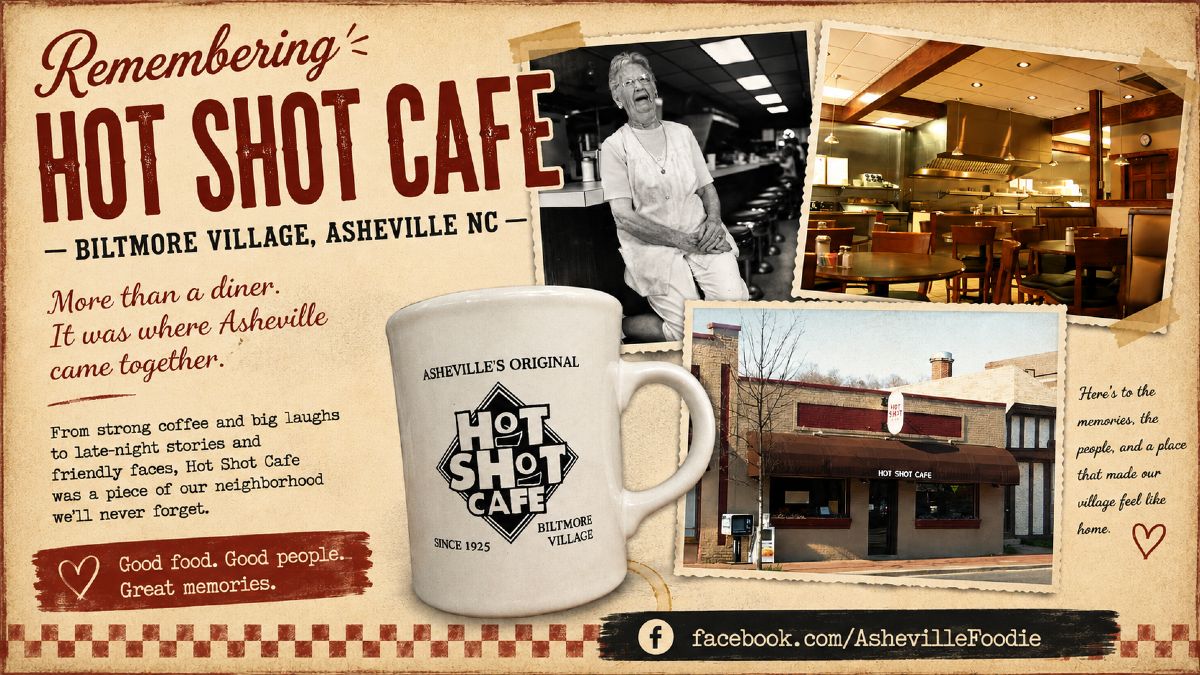
In a city now celebrated for its culinary innovation and ever-evolving food scene, it’s easy to forget the places that built the foundation.
Before the craft cocktails, the curated menus, and the national attention, there were diners—honest, unpretentious spaces where the food was simple, the coffee was strong, and the people were unforgettable.
Hot Shot Cafe, tucked into Biltmore Village in Asheville, was one of those places.
And for nearly a century, it did something far more important than just serve breakfast—it became part of the city’s cultural fabric.
A Nearly 100-Year Legacy
Founded in 1925, Hot Shot Cafe stood as one of Asheville’s longest-running eateries—a rare survivor through decades of change.
It witnessed:
- The transformation of Biltmore Village
- The ebb and flow of tourism
- The rise of Asheville as a culinary destination
Yet somehow, it remained unchanged in the ways that mattered most.
There was no reinvention. No rebrand.
Just consistency.
The same counter.
The same rhythms.
The same unapologetic personality.
The Beauty of “Unpolished”
From a historian’s perspective, places like Hot Shot Cafe are invaluable—not because they’re perfect, but because they’re real.
Hot Shot didn’t cater to trends. It didn’t soften its edges.
It leaned into them.
The waitstaff were known as much for their sharp wit as their service. Regulars expected it. Newcomers were often caught off guard—and then quickly welcomed into the humor.
One visitor recalls sitting down, studying the menu for the first time, when a waitress shouted:
“Hurry up, Goober — I ain’t got all darned day!”
The room erupted in laughter.
That moment—equal parts shock, humor, and warmth—captures something essential about Hot Shot Cafe. It wasn’t rude. It was ritual. A kind of social shorthand that said: you’re one of us now.
The Food That Anchored It All
Of course, personality alone doesn’t sustain a restaurant for nearly 100 years.
Hot Shot Cafe delivered where it counted:
- Classic Southern breakfasts
- Eggs, bacon, biscuits, and gravy done right
- No-frills plates that prioritized flavor over flair
The coffee, by all accounts, was strong enough to start your day—and then some.
Reviews over the years often described the cafe as:
- “A true Asheville institution”
- “A step back in time”
- “The kind of place that doesn’t exist anymore”
And that last sentiment is the one that lingers.
A Place That Belonged to Everyone
What made Hot Shot Cafe special wasn’t just its longevity or its menu—it was its accessibility.
It was a place where:
- Locals and tourists sat side by side
- Construction workers and professionals shared the same counter
- Conversations flowed as freely as the coffee
There was no pretense. No exclusivity.
In an increasingly curated food culture, that kind of openness is rare—and deeply missed.
The Quiet Loss of an Institution
When Hot Shot Cafe closed, it didn’t just leave behind an empty building.
It left a gap in Asheville’s identity.
Because places like this aren’t easily replaced. You can recreate a menu. You can redesign a space. But you can’t manufacture decades of shared experience, humor, and community.
From a culinary history standpoint, Hot Shot Cafe represents something essential:
A reminder that food culture isn’t just about innovation—it’s about continuity.
Why It Still Matters
Asheville continues to grow, evolve, and attract national attention for its food scene—and rightly so.
But in celebrating what’s new, there’s value in remembering what came before.
Hot Shot Cafe wasn’t flashy.
It wasn’t trendy.
It didn’t need to be.
It was authentic.
And that authenticity—the laughter, the grit, the sense of belonging—is what people remember most.
A Final Thought
If you ever sat at that counter…
If you ever got teased by a waitress…
If you ever laughed with strangers over a cup of coffee…
Then you were part of something bigger than a meal.
You were part of Hot Shot Cafe.
And in a city built on stories, that’s one worth holding onto.
